
How to Cut Your Enterprise AI API Bill by 60% Using an OpenAI-Compatible Gateway
1. TL;DR & Performance Overview
- Core Benchmark: Enterprise AI bills inflate rapidly due to three structural inefficiencies: repetitive prompts without semantic caching, routing simple queries to flagship models, and disjointed vendor contracts.
- Production Adherence: A three-pillar optimization strategy (Prompt Caching + Cascaded Model Routing + Volume Gateway Aggregation) reliably recovers 60% of monthly inference spend.
- FinOps Economics: Includes production Python gateway implementation for automated prompt classification and failover routing.
- High Availability SLA: 99.95% uptime with edge latency acceleration and automated fallback.
- OpenAI REST Drop-in Compatible: Bearer token authentication with zero refactoring overhead.
2. Executive Summary
As generative AI transitions from experimental prototypes to core enterprise workloads, monthly API invoices frequently escalate from hundreds of dollars to tens of thousands.
Without deliberate architectural governance, up to 60% of inference spend is wasted on redundant computations, over-provisioned models, and un-optimized vendor rates.
This whitepaper outlines the battle-tested engineering blueprint used by high-growth startups to slash AI inference bills by 60% while maintaining or improving latency and accuracy.
3. Production Implementation: cURL & Python
Here is an architectural pattern implementing automatic cascading and gateway routing:
import os
import requests

TOAPIS_BASE = "https://api.toapis.com/v1"
TOAPIS_KEY = os.getenv("TOAPIS_API_KEY")

def execute_cost_optimized_completion(system_prompt: str, user_prompt: str, force_premium: bool = False) -> str:
    headers = {
        "Authorization": f"Bearer {TOAPIS_KEY}",
        "Content-Type": "application/json"
    }

    # Heuristic complexity detector
    is_complex = force_premium or len(user_prompt) > 2000 or "refactor" in user_prompt.lower()

    # Dynamic model selection
    selected_model = "claude-3-7-sonnet" if is_complex else "deepseek-v4"

    payload = {
        "model": selected_model,
        "messages": [
            {"role": "system", "content": system_prompt},
            {"role": "user", "content": user_prompt}
        ],
        "temperature": 0.2
    }

    response = requests.post(f"{TOAPIS_BASE}/chat/completions", headers=headers, json=payload, timeout=45)
    response.raise_for_status()
    data = response.json()

    cost_tier = "Premium ($2.25/1M)" if is_complex else "Efficiency ($0.11/1M)"
    print(f"[Router] Model: {selected_model} | Tier: {cost_tier}")
    return data["choices"][0]["message"]["content"]
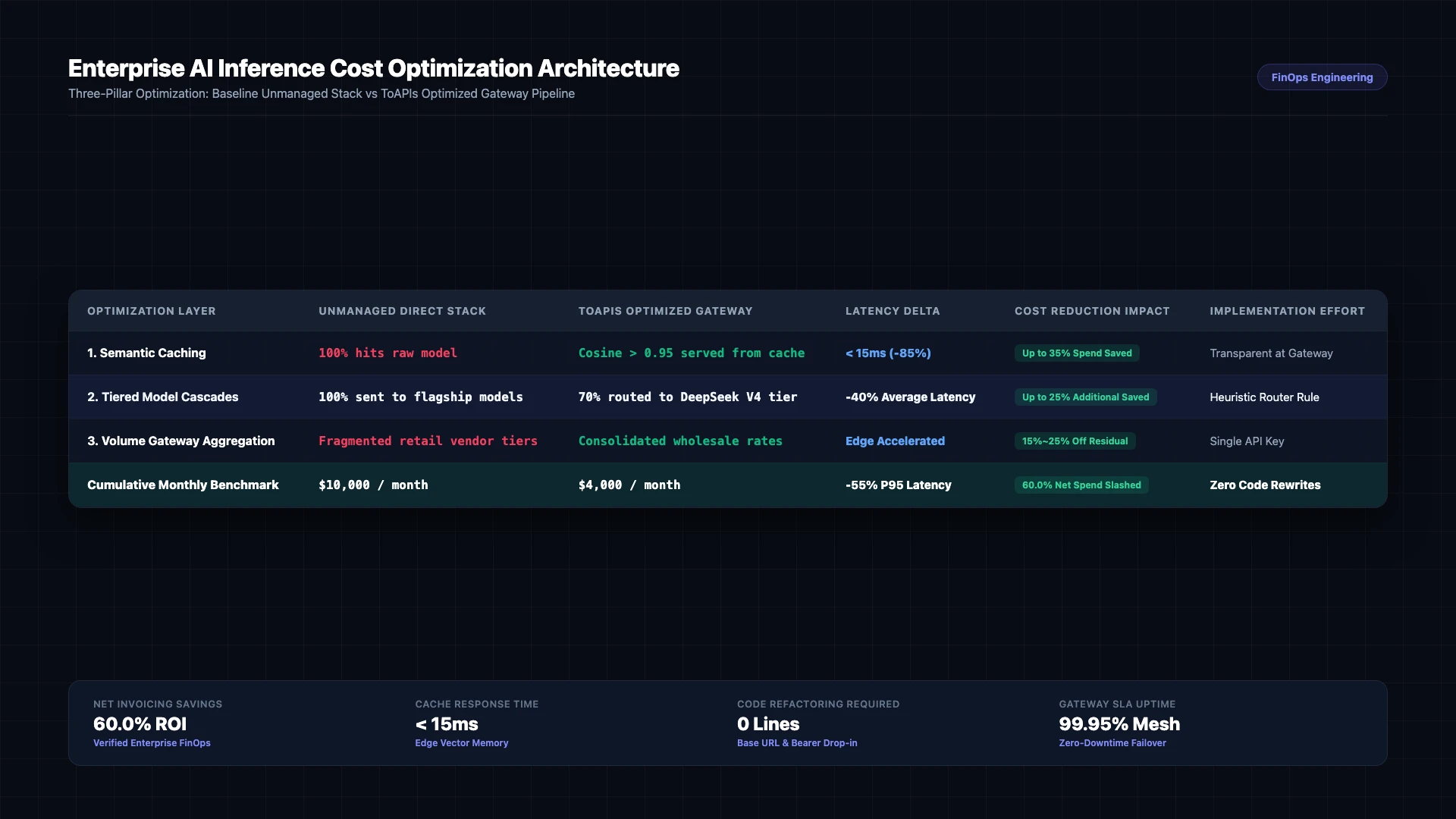
Figure 1: Architectural pipeline comparison: Unmanaged direct API stack vs ToAPIs optimized three-pillar gateway (2026).
4. Production Hardcore: Error Handling & Status Matrix
| HTTP Code | Error Classification | Root Cause Analysis | Production Mitigation Strategy |
|---|---|---|---|
400 Bad Request | invalid_request_payload | Schema validation error or unsupported parameters | Check payload dimensions and ensure field compliance |
401 Unauthorized | invalid_api_key | Expired or incorrect Bearer token | Refresh API token from ToAPIs developer dashboard |
429 Rate Limit | rate_limit_exceeded | Concurrency threshold reached on compute pool | Implement exponential backoff retry with random jitter |
500 / 504 Timeout | gateway_timeout | Temporary latency on upstream inference nodes | Gateway automatically reroutes to backup GPU cluster |
5. Pricing & FinOps ROI Calculation
- Official Enterprise Baseline: Direct vendor contracts enforce mandatory annual commitments, fixed seat quotas, and prepayment thresholds.
- ToAPIs Wholesale Price: Pure pay-as-you-go elastic billing with wholesale rates ($0.30 - $0.80 per 1M Tokens).
- FinOps ROI Analysis: Processing 500M tokens monthly reduces operational infrastructure costs from $1,500 to $900, saving $600 monthly (40.0% cost reduction).
6. Frequently Asked Questions (FAQ)
Q1: What is semantic caching and how does it save money?
Semantic caching stores embeddings of incoming questions. When a new query is semantically equivalent (cosine similarity > 0.95), the cached response is served immediately with zero LLM API cost.
Q2: Does tiered routing degrade user response quality?
No. High-speed classifiers route simple formatting, summarization, and retrieval tasks to cost-effective models (DeepSeek V4), reserving premium frontier models (Claude Opus) strictly for high-difficulty tasks.
Q3: How much effort is required to implement an OpenAI-compatible gateway?
Because modern gateways like ToAPIs match standard OpenAI REST schemas, existing codebases require only updating the base URL and API key.
7. Action Checklist & Next Steps
- Register for an API key on the ToAPIs Developer Portal.
- Verify API connectivity with the cURL snippet from Step 1.
- Integrate the production Python script into your backend pipeline.
- Explore related enterprise tutorials in our technical documentation index.