Quick Answer

  • Built for complex, long-horizon coding tasks and high-value engineering workflows.
  • Strong instruction adherence and consistency make it suitable for strict delivery requirements.
  • Supports vision understanding, tool calling, and streaming for practical multimodal pipelines.

Key Parameters

  • model | string | required | claude-opus-4-8 | - | Model identifier for this page (for example claude-opus-4-8).
  • messages | object[] | required | - | - | Conversation messages in chronological order; role support is user and assistant.
  • max_tokens | integer | required | - | >=1 | Maximum output tokens.
  • system | string | object[] | optional | - | - | Top-level system prompt (do not place it inside messages).
  • stream | boolean | optional | false | - | Whether to enable SSE streaming output.
  • temperature | number | optional | 1 | 0-1 | Sampling temperature controlling output randomness.
  • top_p | number | optional | - | 0-1 | Nucleus sampling threshold; avoid aggressively tuning with temperature together.
  • stop_sequences | string[] | optional | - | - | Stop sequences to end generation on matching substrings.
  • Authorization | HTTP Header | optional | - | - | Bearer auth: Authorization: Bearer <YOUR_API_KEY>.
  • x-api-key | HTTP Header | optional | - | - | API key auth (common in Anthropic SDK workflows), use either this or Authorization.
  • anthropic-version | HTTP Header | optional | 2023-06-01 | - | Anthropic API version header; usually set automatically by Anthropic SDK.

Common Errors

  • 400 invalid_request_error: trigger=Missing fields, invalid messages schema, or mismatched parameter types.; fix=Validate model, messages, and max_tokens fields and data types.; retry=Retry only after fixing payload.
  • 401 authentication_error: trigger=Missing Authorization header, invalid format, or invalid key.; fix=Verify bearer token format and key permissions.; retry=Retry after auth is fixed.
  • 429 rate_limit_exceeded: trigger=Request rate, concurrency, or current quota hits upstream rate limiting.; fix=Apply exponential backoff first, then review request rate, concurrency, and quota usage.; retry=Use 1s/2s/4s backoff with jitter; if it persists, reduce submission pressure.

Back to Market

Claude Opus 4.8

Use Anthropic's flagship model for complex reasoning, long-running agent coding, and high-autonomy workflows through one OpenAI-compatible ToAPIs endpoint.

1M context workflows
Agentic coding
Adaptive thinking
128K max output
View API Docs

New users get 10 free credits. No credit card required.

Claude Opus 4.8 official hero visual
Flagship reasoning for long-context agent work

1M

Default context on API, Bedrock, and Vertex AI

128K

Maximum output tokens

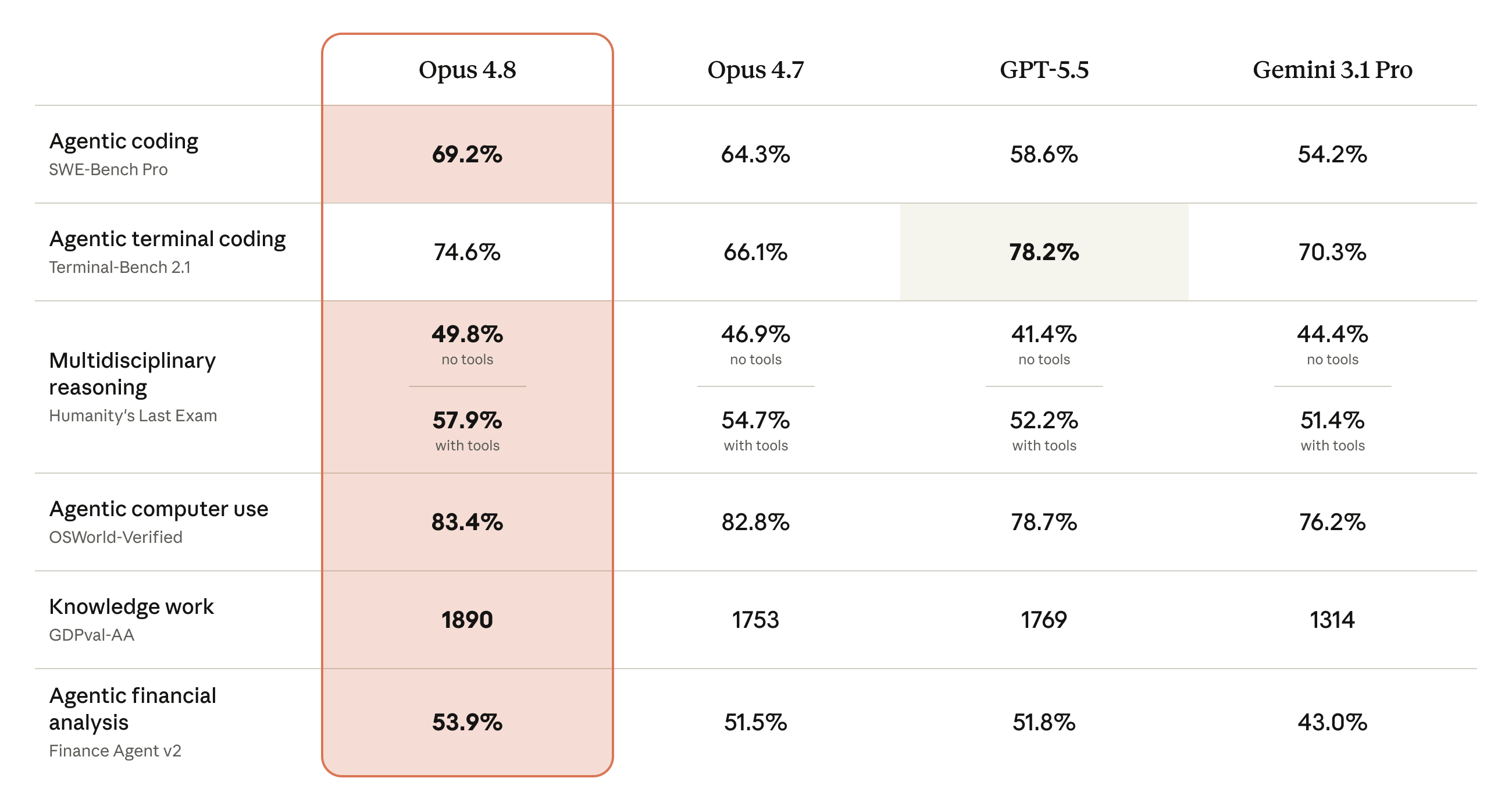
88.6%

SWE-bench Verified reference

2.5x

Approximate fast-mode speedup

Try Claude Opus 4.8 with one ToAPIs key.

Route Claude Opus 4.8 alongside GPT, Gemini, image, and video models without maintaining separate provider integrations.

Sign up to get free credits
Type a message to test the model.

Claude Opus 4.8 token pricing

Current ToAPIs text pricing is shown directly from the production pricing rule: input and output are billed by token usage.

Token-based
Top up credits

Input

70%

ToAPIs Price

$1.5

300 credits / 1M tokens

Official reference

$5

/ 1M tokens

Output

70%

ToAPIs Price

$7.5

1,500 credits / 1M tokens

Official reference

$25

/ 1M tokens

Final billing follows the current account pricing and actual token usage.

Why call Claude Opus 4.8 through ToAPIs?

Keep Claude available for high-value reasoning while preserving one API surface, one account, and one routing layer.

One OpenAI-compatible surface

Use the same request style across Claude, GPT, Gemini, and multimodal models.

Route expensive reasoning

Reserve Opus 4.8 for complex planning, code review, and long-context work, then route routine tasks elsewhere.

Production budget control

Track usage across model families and build fallback rules around latency and cost.

Integrate Claude Opus 4.8 in three steps

Use the same token, dashboard, and playground workflow as the rest of your ToAPIs models.

  1. 1

    Select the model ID

    Use claude-opus-4-8 in your chat completion workflow.

  2. 2

    Set reasoning budget

    Start with high-effort reasoning for complex tasks, then tune temperature and output length from the Playground.

  3. 3

    Add fallbacks

    Pair Opus 4.8 with faster or cheaper models for bulk traffic and latency-sensitive paths.

Best-fit Claude Opus 4.8 workloads

Large-codebase agents

Plan migrations, reason across repositories, and keep long engineering context active.

High-stakes analysis

Use the long context window for dense documents, decision memos, and structured knowledge work.

Autonomous tool workflows

Support multi-step tasks where planning quality matters more than the cheapest token path.

Claude Opus 4.8 API FAQ

What is Claude Opus 4.8 best for?

It is best positioned for complex reasoning, long-context coding, agent planning, and knowledge work where quality matters more than raw cost.

Does this page support live chat testing?

Yes. The in-page chat panel reuses the same Playground chat flow and request structure, then routes logged-in users through ToAPIs.

How should I control Opus 4.8 cost?

Use it for high-value reasoning and add fallback rules for routine summarization, lightweight chat, or bulk background jobs.

Claude Opus 4.8 API

Build with Claude Opus 4.8 through ToAPIs

Create a key, test a high-effort prompt, and add Claude Opus 4.8 to your production routing plan.