
Shipping a production image pipeline in late 2026 rarely fails because an image looks slightly less cinematic. It fails because your workflow burns extra API calls on post-hoc background removal, crashes on an unsupported seed parameter during failover, drifts on edit round six, or silently doubles your monthly invoice when a team defaults to an older Pro SKU.
Comparing Seedream 5.5 vs Nano Banana 2.1 resolves a very concrete engineering choice. Both models sit in the sub-two-cent per-call tier on the ToAPIs international catalog ($0.016 vs $0.015 per call as of November 25, 2026), yet they solve fundamentally different production bottlenecks:
- Seedream 5.5 (
doubao-seedream-5-5, released by ByteDance Seed on November 9, 2026) is built for deterministic design production: native RGBA transparent backgrounds, layer decomposition, crisp small-glyph text rendering, up to 10 reference images, and up to 100 pixel-stable editing turns. - Nano Banana 2.1 (
gemini-nano-banana-2.1, Google DeepMind) is built for reasoning-heavy visual generation: text, image, audio, and video inputs, built-in thinking, Google Search and Image Search grounding, C2PA Content Credentials, and conversational editing.
Scope and evidence boundary. Specifications below are grounded in official ByteDance Seed and Google DeepMind documentation plus the live ToAPIs international pricing catalog checked on November 25, 2026. Cost calculations use verified catalog and list rates with stated workload formulas. We did not execute paid live inference runs for this guide, so wall-clock p50/p95 latency and subjective visual win rates on your prompt set are marked as unverified—Section 6 provides a reproducible Python harness so your team can measure latency and cost per accepted image directly against your own acceptance rubric.
1. Unified API Quickstart: Switch Models With One Payload
If you evaluate both image models through separate vendor consoles, you end up managing two billing portals, two auth stacks, and incompatible retry paths. Behind ToAPIs (https://api.toapis.com/v1), both doubao-seedream-5-5 and gemini-nano-banana-2.1 share a unified Bearer token and image-generation endpoint contract.
Minimal cURL: Calling Seedream 5.5 (With Native RGBA Transparency)
Export your API key first (never hardcode keys in source files):
export TOAPIS_API_KEY="your-api-key-here"
Request a 1K transparent product cutout with doubao-seedream-5-5:
curl -sS https://api.toapis.com/v1/images/generations \
  -H "Authorization: Bearer ${TOAPIS_API_KEY}" \
  -H "Content-Type: application/json" \
  -d '{
    "model": "doubao-seedream-5-5",
    "prompt": "Isolated matte ceramic pour-over coffee dripper on transparent background, crisp studio edge lighting, commercial product asset",
    "size": "1K",
    "aspect_ratio": "1:1",
    "metadata": {
      "background": "transparent",
      "watermark": false
    }
  }'
Minimal cURL: Calling Nano Banana 2.1 (Layout & Grounded Generation)
Swap the model field to gemini-nano-banana-2.1—and deliberately omit unsupported sampling fields (seed, temperature, top_p, top_k, logprobs):
curl -sS https://api.toapis.com/v1/images/generations \
  -H "Authorization: Bearer ${TOAPIS_API_KEY}" \
  -H "Content-Type: application/json" \
  -d '{
    "model": "gemini-nano-banana-2.1",
    "prompt": "Clean editorial infographic card showing a four-stage coffee roasting temperature curve from green bean to dark roast, accurate Celsius labels, minimalist flat design",
    "resolution": "1K",
    "aspect_ratio": "16:9"
  }'
Expected 200 OK Response Shape
Both routes return a consistent JSON envelope containing either hosted asset URLs or base64 payloads depending on response format configuration:
{
  "created": 1764067200,
  "model": "doubao-seedream-5-5",
  "data": [
    {
      "url": "https://files.example.com/generated/asset-0193a7.png",
      "revised_prompt": "Isolated matte ceramic pour-over coffee dripper on transparent background..."
    }
  ],
  "usage": {
    "images": 1
  }
}
Production Python Client With Model-Aware Parameter Sanitization
The safest way to run Seedream 5.5 vs Nano Banana 2.1 side by side is a small adapter layer that enforces each model's schema constraints before the HTTP request leaves your service:
import os
import time
import random
from typing import Any, Optional
import requests

BASE_URL = os.getenv("TOAPIS_BASE_URL", "https://api.toapis.com/v1")
API_KEY = os.getenv("TOAPIS_API_KEY", "your-api-key-here")

NANO_BANANA_FORBIDDEN_KEYS = {"seed", "temperature", "top_p", "topP", "top_k", "topK", "logprobs"}


def build_image_payload(
    model: str,
    prompt: str,
    *,
    aspect_ratio: str = "16:9",
    size_tier: str = "1K",
    reference_images: Optional[list[str]] = None,
    transparent_bg: bool = False,
    layer_decomposition: bool = False,
    watermark: bool = False,
    extra: Optional[dict[str, Any]] = None,
) -> dict[str, Any]:
    """Build a schema-safe payload for doubao-seedream-5-5 or gemini-nano-banana-2.1."""
    payload: dict[str, Any] = {
        "model": model,
        "prompt": prompt,
        "aspect_ratio": aspect_ratio,
    }

    if model.startswith("doubao-seedream-5-5"):
        payload["size"] = size_tier  # Supported tiers: 1K, 1.5K, 2K
        metadata: dict[str, Any] = {"watermark": watermark}
        if layer_decomposition:
            # Critical contract: layer_decomposition requires exactly 1 reference image
            # and MUST omit metadata.background (even "opaque").
            if not reference_images or len(reference_images) != 1:
                raise ValueError("Seedream 5.5 layer_decomposition requires exactly 1 reference image.")
            payload["image"] = reference_images
            metadata["layer_decomposition"] = True
        else:
            if reference_images:
                if len(reference_images) > 10:
                    raise ValueError("Seedream 5.5 supports at most 10 reference images.")
                payload["image"] = reference_images
            if transparent_bg:
                metadata["background"] = "transparent"
        payload["metadata"] = metadata

    elif model.startswith("gemini-nano-banana-2.1"):
        payload["resolution"] = size_tier  # Standard 1K/2K; 4K on official token-billed route
        if reference_images:
            payload["image"] = reference_images
        if extra:
            sanitized = {k: v for k, v in extra.items() if k not in NANO_BANANA_FORBIDDEN_KEYS}
            payload.update(sanitized)
    else:
        if extra:
            payload.update(extra)

    return payload


def generate_image_with_backoff(payload: dict[str, Any], max_retries: int = 4, timeout: float = 90.0) -> dict[str, Any]:
    """Submit an image generation request with exponential backoff and jitter on 429/5xx."""
    headers = {
        "Authorization": f"Bearer {API_KEY}",
        "Content-Type": "application/json",
    }
    url = f"{BASE_URL}/images/generations"

    for attempt in range(max_retries + 1):
        resp = requests.post(url, headers=headers, json=payload, timeout=timeout)
        if resp.status_code == 200:
            return resp.json()
        if resp.status_code in (429, 500, 502, 503, 504) and attempt < max_retries:
            retry_after = resp.headers.get("Retry-After")
            base_delay = float(retry_after) if retry_after and retry_after.isdigit() else (2 ** attempt)
            jitter = random.uniform(0.2, 0.9)
            time.sleep(min(base_delay + jitter, 30.0))
            continue
        resp.raise_for_status()

    raise RuntimeError("Exceeded maximum retries for image generation.")
Notice what this adapter prevents right out of the box: passing layer_decomposition=True alongside transparent_bg=True will never leak metadata.background into Seedream 5.5, and accidental caller overrides like seed=42 or temperature=0.7 are stripped before hitting Nano Banana 2.1.
2. Architecture & Parameter Contracts: Seedream 5.5 vs Nano Banana 2.1
Evaluating Seedream 5.5 vs Nano Banana 2.1 solely on sample galleries misses the architectural differences that dictate what your application can actually ship. The table below consolidates verified first-party capabilities and ToAPIs catalog contracts as of November 25, 2026:
| Technical Dimension | Seedream 5.5 (doubao-seedream-5-5) | Nano Banana 2.1 (gemini-nano-banana-2.1) | Engineering Implication |
|---|---|---|---|
| Vendor & Release | ByteDance Seed (released Nov 9, 2026) | Google DeepMind (Gemini image ecosystem) | Both are active late-2026 production models |
| Input Modalities | Text (up to 10,000 chars) + up to 10 reference images | Text, Image, Audio, Video (131,072-token context) | Nano Banana 2.1 handles non-image conditioning (video/audio cues) |
| Output Modalities | Image (opaque or native RGBA transparent PNG) | Text + Image (up to 32,768 output tokens) | Nano Banana 2.1 can return reasoning text alongside imagery |
| Resolution Tiers | 1K, 1.5K, 2K | 1K, 2K; up to 4K on gemini-nano-banana-2.1-official | Choose Nano Banana 2.1 official route when native 4K print output is mandatory |
| Aspect Ratios | 1:1, 3:2, 16:9, 21:9, 9:16, 2:3, 3:4, 4:3 | Flexible standard & editorial ratios | Both cover desktop banners, mobile vertical, and square catalogs |
| Native RGBA Transparency | Yes (metadata.background: "transparent", partial + full alpha) | Not a native RGBA alpha-layer contract | Seedream 5.5 removes downstream background-removal steps |
| Layer Decomposition | Yes (layer_decomposition: true with 1 reference image) | No native layer-decomposition mode | Seedream 5.5 fits sticker packs, UI sprites, and editable design layers |
| Multi-Turn Edit Stability | Pixel-stable up to 100 consecutive editing rounds | Conversational multi-turn editing with layout reasoning | Seedream 5.5 preserves unedited pixels; Nano Banana 2.1 excels at semantic re-layout |
| Built-in Reasoning & Grounding | Standard prompt-following (strong dense/small typography) | Built-in Thinking + Google Search & Image Search grounding | Nano Banana 2.1 handles world-knowledge and factual layout prompts better |
| Provenance / Trust | Optional watermark toggle (metadata.watermark) | Content Credentials (C2PA) metadata + implicit context caching | Regulated publishers and enterprise ad tech often require C2PA |
| Strict Parameter Restrictions | Omit metadata.background when layer_decomposition=true | Official API rejects seed, temperature, topP, topK, logprobs | Mandatory payload sanitization in any shared gateway client |
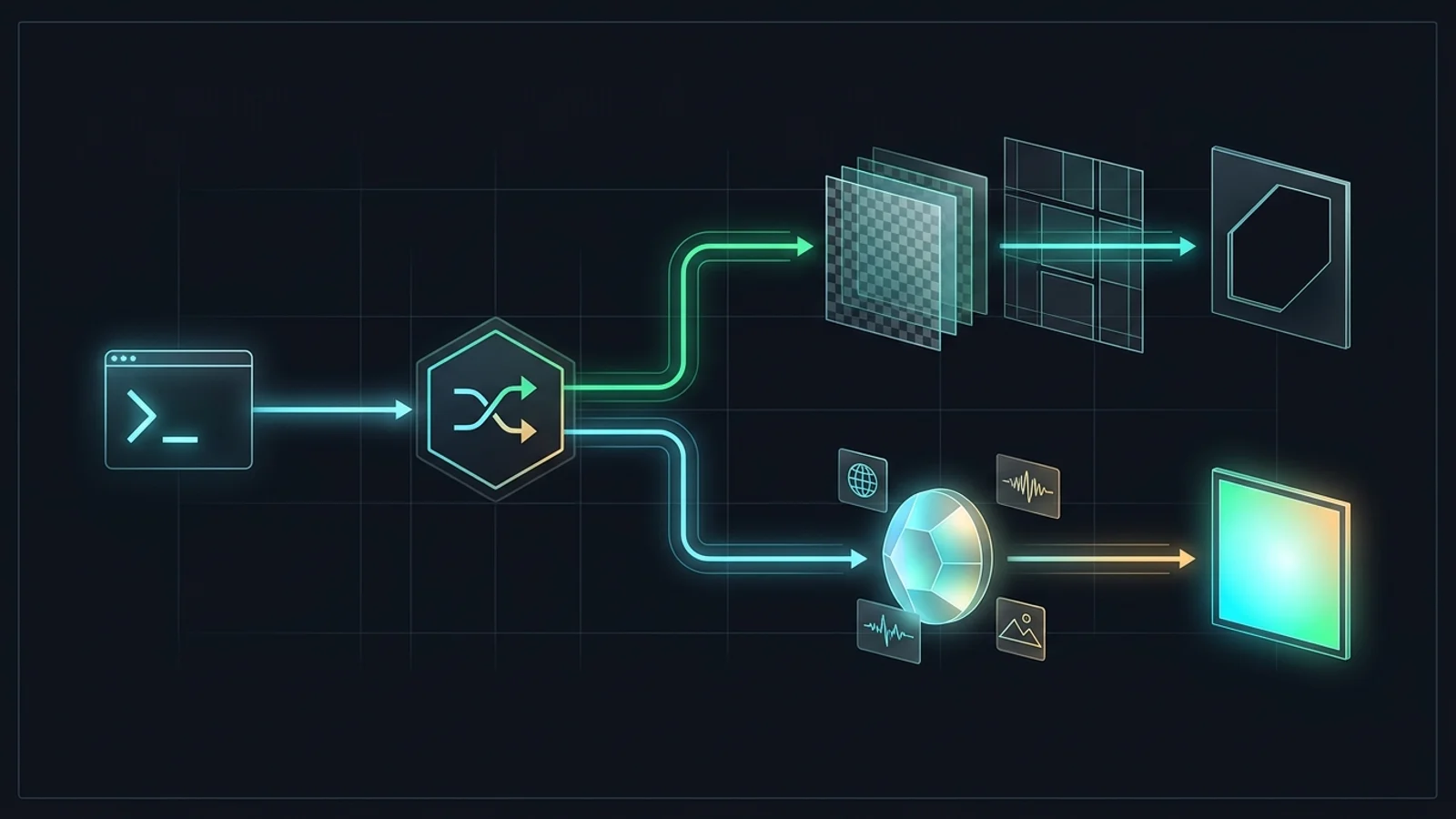
Figure 1: Conceptual routing architecture comparing Seedream 5.5 native RGBA/layer workflows against Nano Banana 2.1 multimodal thinking and grounded image pipelines behind a unified ToAPIs gateway (2026, original architectural illustration).
How a Dual-Model Router Decides at Request Time
Instead of hardcoding a single model for your entire product, route dynamically on request intent:
This routing policy immediately eliminates the false dichotomy between the two models: design-asset pipelines go to Seedream 5.5, while reasoning-grounded, C2PA-audited, or 4K pipelines go to Nano Banana 2.1.
3. Production Failure Modes and Defensive Routing Patterns
Most blog comparisons stop at marketing specs and ignore the exact edge cases that page on-call engineers at 2:00 AM. Here are the four concrete failure modes we audit before deploying either model into production.
Failure Mode 1: The layer_decomposition + metadata.background Collision on Seedream 5.5
On ToAPIs's doubao-seedream-5-5 contract, ordinary generation accepts metadata.background (for example "transparent" or "opaque"). However, when layer_decomposition is enabled:
- You must supply exactly one reference image (supplying zero or multiple images triggers validation failure).
- You must completely omit
metadata.background—even setting it to"opaque"conflicts with layer decomposition mode, whilemetadata.watermarkremains valid. - The text prompt becomes optional during pure layer splitting.
Fix: Keep layer_decomposition in a dedicated branch of your payload builder (as shown in Section 1) rather than merging default generation metadata blindly.
Failure Mode 2: Sampling Parameter Rejection on Nano Banana 2.1
Teams migrating from Flux, SDXL, or OpenAI chat-wrapper pipelines frequently pass seed, temperature, topP, topK, or logprobs inside a shared request helper. Google's official gemini-nano-banana-2.1 endpoint explicitly does not support those parameters and returns an API error if any of them are present.
Fix: Maintain an explicit allowlist per model (resolution, aspect_ratio, prompt, image) or strip NANO_BANANA_FORBIDDEN_KEYS in middleware. If your QA tests relied on fixed seed determinism to detect regressions, switch your regression harness to structural and visual rubric assertions (text OCR match, subject bounding-box presence, alpha channel verification) rather than byte-identical image hashes.
Failure Mode 3: Multi-Turn Drift vs Semantic Over-Editing
Both models support iterative editing, but they fail differently under repeated turns:
- Pixel-locked asset edits (packaging color swaps, logo placement, seasonal badge updates): If an editor subtly alters lighting or warps unchanged text on round four, the asset fails brand review. Seedream 5.5 is engineered specifically for pixel stability across up to 100 consecutive editing rounds, keeping unedited regions locked while updating only the requested region.
- Conceptual re-composition ("move the subject into a snowy Tokyo alley at dusk and explain the architectural changes"): Pixel locking can work against you when the whole scene needs global lighting, perspective, and world-knowledge coherence. Nano Banana 2.1's built-in thinking and multimodal context shine here because it reasons through spatial layout before rendering.
Fix: Cap blind retry loops at 2 attempts on the same model. If an edit fails because the background drifted, route the retry to doubao-seedream-5-5. If it fails because the model misunderstood a real-world object, geography, or multi-step diagram constraint, route the retry to gemini-nano-banana-2.1.
Failure Mode 4: Timeout Tuning, Idempotency, and Cross-Model Fallback
Image generation latencies fluctuate during regional traffic bursts, especially for 2K/4K outputs or multi-reference edits:
- HTTP timeout: Set client read timeouts to 60–90 seconds for synchronous 1K/2K requests and 120 seconds for 4K or heavy multi-reference requests. Short 15-second defaults cause premature client aborts while the upstream job still completes and bills your account.
- Idempotency key: Generate a deterministic request ID per user job (
job_id + attempt_hash) and cache completed asset URLs in Redis/object storage before returning to the client so frontend retries never trigger duplicate billable generations. - Graceful degradation: Only fall back across models when the task does not depend on an exclusive feature. Never fall back a
transparent_bg=Trueorlayer_decomposition=TrueSeedream 5.5 job to Nano Banana 2.1 without chaining a background-removal step, and never fall back a C2PA-required compliance job to a model without C2PA metadata.
def safe_fallback_model(primary_model: str, *, requires_rgba: bool, requires_c2pa: bool) -> Optional[str]:
    """Return a compatible fallback model only when hard feature contracts allow it."""
    if primary_model == "doubao-seedream-5-5":
        return None if requires_rgba else "gemini-nano-banana-2.1"
    if primary_model == "gemini-nano-banana-2.1":
        return None if requires_c2pa else "doubao-seedream-5-5"
    return None
Failure Mode 5: Ephemeral Asset URLs, Format Normalization, and Migration Checklist
Upstream image URLs returned by generation endpoints are frequently time-limited signed links. Never store raw upstream URLs directly in your production database or embed them in customer-facing HTML:
- Immediate object-storage mirror: Stream the returned PNG or JPEG bytes straight into your own S3 or Cloudflare R2 bucket within the worker process, and serve immutable WebP or PNG derivatives behind a CDN (
Cache-Control: public, max-age=31536000, immutable). - Preserve alpha channels during transcoding: When mirroring
doubao-seedream-5-5transparent outputs, verify that your image pipeline writes RGBA-capable PNG or WebP (converting to JPEG silently flattens transparency into a solid black or white box). - Preserve C2PA provenance headers when required: Aggressive re-encoding strips embedded C2PA Content Credentials from
gemini-nano-banana-2.1outputs. If your publishing or ad-tech compliance workflow verifies provenance, store the original untouched asset alongside any resized WebP preview. - Five-minute migration checklist from legacy single-vendor image SDKs:
- Replace vendor-specific base URLs with
https://api.toapis.com/v1and move credentials intoTOAPIS_API_KEY. - Swap legacy model strings (
doubao-seedream-5-0-proor older flash image IDs) todoubao-seedream-5-5orgemini-nano-banana-2.1behind a feature flag so you can shift 10% of traffic first. - Add automated payload validation unit tests covering the two hard traps: stripping
seed/temperature/topP/topK/logprobsfor Nano Banana 2.1, and omittingmetadata.backgroundwheneverlayer_decomposition=trueon Seedream 5.5. - Log
model,resolution/size,status_code,elapsed_ms, andretry_counton every request so finance and engineering share one ground-truth ledger for cost per accepted image. - Configure budget alerts per model SKU so an accidental loop targeting a 4K token-billed route (
gemini-nano-banana-2.1-official) cannot silently exhaust monthly credits overnight.
- Replace vendor-specific base URLs with
4. Unit Economics and Monthly Bill Math: Seedream 5.5 vs Nano Banana 2.1
Pricing comparisons often mislead engineering leaders by quoting only a single promotional 1K rate while ignoring official list spreads, resolution surcharges, legacy Pro models, and downstream pipeline costs.
Verified Rate Card (Checked November 25, 2026)
| Model & Billing Route | Billing Mode | Official Reference List Price | ToAPIs Live Catalog Rate | Notes & Scope |
|---|---|---|---|---|
doubao-seedream-5-5 | Per call (quota_type: 1) | ~$0.020 (1K–1.5K) / ~$0.035 (2K) | $0.016 / call | 20% below BytePlus 1K–1.5K list; ~62% below Seedream 5.0 Pro |
gemini-nano-banana-2.1 | Per call (quota_type: 1) | ~$0.0336 / 1K image (standard) | $0.015 / call | ~55% below standard official 1K list price |
gemini-nano-banana-2.1-official | Token-billed (quota_type: 0) | Variable by input/output tokens + 4K tier | Catalog ratio (0.6 / 5.0) | Supports up to 4K; check live token estimator before high-volume runs |
doubao-seedream-5-0-pro (baseline) | Per call (quota_type: 1) | Higher legacy Pro tier | $0.042857 / call | Useful internal baseline showing Seedream 5.5 generational savings |
Sources: Official BytePlus / ByteDance Seed and Google Gemini API reference documentation, plus https://toapis.com/api/pricing checked November 25, 2026. Official figures are USD reference rates before taxes; ToAPIs figures reflect live public catalog rates on that date and may change by resolution tier or account plan.
Three Realistic Monthly Production Bills
Let $N$ be monthly accepted assets, $p$ be first-pass acceptance rate ($0 < p \le 1$), $c_{\text{gen}}$ be unit generation cost, and $c_{\text{post}}$ be any downstream post-processing cost (such as an external $0.005/image background-removal API):
Scenario A: 10,000 Transparent E-Commerce Product Cutouts / Month
Suppose both models achieve an assumed 85% acceptance rate ($p = 0.85 \Rightarrow 11{,}765$ billed calls), and a non-RGBA workflow requires a $0.005 background-removal call on the 10,000 accepted images:
- Seedream 5.5 (
doubao-seedream-5-5, native RGBA, $c_{\text{post}} = $0$):- $11{,}765 \times $0.016 = \mathbf{$188.24 / \text{month}}$ (vs
$235.30at BytePlus$0.020list, or$504.21on legacydoubao-seedream-5-0-pro—saving $315.97/month over 5.0 Pro).
- $11{,}765 \times $0.016 = \mathbf{$188.24 / \text{month}}$ (vs
- Nano Banana 2.1 (
gemini-nano-banana-2.1+$0.005external cutout API):- $11{,}765 \times $0.015 + 10{,}000 \times $0.005 = $176.48 + $50.00 = \mathbf{$226.48 / \text{month}}$.
- Verdict: Even though Nano Banana 2.1 is
$0.001cheaper per raw call, native RGBA makes Seedream 5.5 16.9% cheaper end-to-end on cutout workflows—and avoids mask-halo edge artifacts.
Scenario B: 25,000 Grounded Editorial & Infographic Visuals / Month (No Transparency Needed)
Suppose your app generates fact-checked diagrams, news explainers, or location-accurate scenes where reasoning reduces retries:
- Nano Banana 2.1 at $p = 0.90$ ($27{,}778$ calls):
- On ToAPIs (
$0.015/call): $27{,}778 \times $0.015 = \mathbf{$416.67 / \text{month}}$. - On official Gemini API (
$0.0336/1K): $27{,}778 \times $0.0336 = \mathbf{$933.34 / \text{month}}$ (55.4% savings via ToAPIs per-call route).
- On ToAPIs (
- Seedream 5.5 at $p = 0.75$ (more retries on world-knowledge prompts, $33{,}334$ calls):
- On ToAPIs (
$0.016/call): $33{,}334 \times $0.016 = \mathbf{$533.34 / \text{month}}$.
- On ToAPIs (
- Verdict: Acceptance rate dominates raw unit price. A 15-percentage-point gain in first-pass pass rate cuts total spend by 21.9%—far outweighing the
$0.001catalog price difference.
Scenario C: Cost-Per-Accepted-Asset Sensitivity Matrix
| First-Pass Acceptance Rate ($p$) | Seedream 5.5 Effective Cost / Accepted Asset ($0.016 base) | Nano Banana 2.1 Effective Cost / Accepted Asset ($0.015 base) | Legacy Seedream 5.0 Pro ($0.042857 base) |
|---|---|---|---|
| 95% | $0.0168 | $0.0158 | $0.0451 |
| 85% | $0.0188 | $0.0176 | $0.0504 |
| 70% | $0.0229 | $0.0214 | $0.0612 |
| 50% | $0.0320 | $0.0300 | $0.0857 |
Note: Effective cost excludes failed non-billed network drops and assumes every HTTP 200 generation is billed. Wall-clock latency (p50/p95) and real acceptance rates for your prompt distribution are unverified in this guide; run Section 6 to populate your own numbers.
5. Workload Selection Matrix: When to Route Each Model
An honest Seedream 5.5 vs Nano Banana 2.1 decision must state where each model is weaker, not just where it shines:
| Production Workload | Recommended Route | Why It Wins | Honest Trade-Off / Watch-Out |
|---|---|---|---|
| E-commerce product cutouts, stickers, UI icons | doubao-seedream-5-5 | Native RGBA transparency + layer_decomposition skips post-processing | Max resolution is 2K; if you need native 4K print files, add an upscaler |
| Multi-turn brand asset editing (5–100 rounds) | doubao-seedream-5-5 | Pixel-stable unedited regions prevent logo and background drift | Strictly omit metadata.background during layer decomposition |
| Dense posters, menus, small typography | doubao-seedream-5-5 | Specialized dense text and small glyph fidelity + 10-ref consistency | Not grounded in live web search for current events |
| World-knowledge graphics, maps, factual scenes | gemini-nano-banana-2.1 | Built-in Thinking + Google Search / Image Search grounding | Rejects seed, temperature, topP, topK, logprobs |
| Audio- or video-conditioned visual creation | gemini-nano-banana-2.1 | Native text + image + audio + video input modalities | No native RGBA transparent layer-splitting contract |
| Enterprise publishing needing provenance | gemini-nano-banana-2.1 | C2PA Content Credentials metadata built in | Check token billing if switching to gemini-nano-banana-2.1-official for 4K |
| Native 4K hero assets without external upscaling | gemini-nano-banana-2.1-official | Up to 4K resolution supported on official token-billed route | Higher variable token cost than $0.015 1K/2K per-call SKU |
6. Reproducible Evaluation Harness for Your Prompt Suite
Because latency and visual acceptance depend heavily on prompt length, reference-image size, and region, run a 20-prompt blind test against your real production queries before locking your routing percentages. The script below runs offline in --dry-run mode to verify payload contracts, or live when --live and TOAPIS_API_KEY are supplied:
#!/usr/bin/env python3
"""Minimal reproducible benchmark harness for Seedream 5.5 vs Nano Banana 2.1."""
import argparse
import json
import os
import statistics
import time
import requests

BASE_URL = os.getenv("TOAPIS_BASE_URL", "https://api.toapis.com/v1")
API_KEY = os.getenv("TOAPIS_API_KEY", "your-api-key-here")

MODELS = {
    "doubao-seedream-5-5": {"unit_cost": 0.016, "size_key": "size"},
    "gemini-nano-banana-2.1": {"unit_cost": 0.015, "size_key": "resolution"},
}

SAMPLE_PROMPTS = [
    {"id": "cutout-01", "prompt": "Matte black wireless earbuds floating at 30-degree angle, transparent background", "rgba": True},
    {"id": "typo-02", "prompt": "Specialty coffee menu board with 6 clearly legible prices and roast origins, warm cafe lighting", "rgba": False},
    {"id": "ground-03", "prompt": "Editorial architectural illustration of Tokyo Station Marunouchi facade at golden hour, 16:9", "rgba": False},
]


def build_req(model: str, item: dict) -> dict:
    cfg = MODELS[model]
    body = {
        "model": model,
        "prompt": item["prompt"],
        cfg["size_key"]: "1K",
        "aspect_ratio": "16:9",
    }
    if model == "doubao-seedream-5-5" and item.get("rgba"):
        body["metadata"] = {"background": "transparent", "watermark": False}
    return body


def run_eval(live: bool) -> None:
    headers = {"Authorization": f"Bearer {API_KEY}", "Content-Type": "application/json"}
    summary = {}

    for model, cfg in MODELS.items():
        latencies = []
        successes = 0
        for item in SAMPLE_PROMPTS:
            payload = build_req(model, item)
            if not live:
                successes += 1
                continue
            t0 = time.perf_counter()
            resp = requests.post(f"{BASE_URL}/images/generations", headers=headers, json=payload, timeout=90)
            elapsed = round(time.perf_counter() - t0, 2)
            if resp.status_code == 200:
                successes += 1
                latencies.append(elapsed)
        summary[model] = {
            "mode": "live" if live else "dry-run",
            "attempted": len(SAMPLE_PROMPTS),
            "http_200": successes,
            "estimated_spend_usd": round(successes * cfg["unit_cost"], 4),
            "median_latency_s": statistics.median(latencies) if latencies else "unverified",
        }

    print(json.dumps(summary, ensure_ascii=False, indent=2))


if __name__ == "__main__":
    parser = argparse.ArgumentParser()
    parser.add_argument("--live", action="store_true", help="Execute paid live requests against TOAPIS_BASE_URL")
    args = parser.parse_args()
    run_eval(live=args.live)
Score the returned images blindly against three pass/fail criteria—(1) alpha edge cleanliness or typography OCR accuracy, (2) zero unprompted subject drift, and (3) zero compliance artifacts—then divide estimated_spend_usd by your count of passing assets to get your true cost per accepted image.
7. Next Steps and Technical Q&A
Both models are live today behind a single key on ToAPIs, so you do not need to pick one permanently before testing on real traffic:
- Inspect parameters, playground fields, and live rates on the Seedream 5.5 Model Guide and Nano Banana 2 Model Guide.
- Verify current per-call vs token-billed rates across all 200+ models on the ToAPIs Pricing Page or browse image models in the Model Market.
- For deeper single-model background and adjacent image pricing baselines, read our Seedream 5.5 API Readiness Guide and GPT Image 2 API Pricing Breakdown.
Technical Q&A
1. In a Seedream 5.5 vs Nano Banana 2.1 migration, can I keep my existing OpenAI SDK client?
Yes, when routing through ToAPIs's OpenAI-compatible /v1/images/generations endpoint, you keep one authentication header and base URL. Keep only a lightweight parameter mapper for model-specific keys (size + metadata for doubao-seedream-5-5; resolution with sampling parameters stripped for gemini-nano-banana-2.1).
2. Should I upgrade from doubao-seedream-5-0-pro directly to doubao-seedream-5-5?
On unit economics alone, doubao-seedream-5-5 ($0.016/call) is roughly 62% less expensive than doubao-seedream-5-0-pro ($0.042857/call) in the live ToAPIs catalog while adding native RGBA transparency and pixel-stable multi-turn editing. Run your existing golden prompt suite through both models using Section 6 before retiring 5.0 Pro.
3. When should I use gemini-nano-banana-2.1-official instead of gemini-nano-banana-2.1?
Use gemini-nano-banana-2.1 ($0.015/call) for predictable per-image billing on 1K–2K production assets. Switch to gemini-nano-banana-2.1-official when you specifically need up to 4K resolution or official token-billed route behavior.
4. Why does this Seedream 5.5 vs Nano Banana 2.1 guide not claim a universal latency winner? Because real p50/p95 latency varies with output resolution (1K vs 2K vs 4K), number of reference images (1 vs 10), and regional load. Publishing one-off stopwatch numbers from a single run creates false confidence; running the Section 6 harness over 20+ representative prompts gives numbers your engineering team can actually rely on.
First-Party Sources
- ByteDance Seed Official Documentation — Seedream model architecture and capabilities overview (checked November 25, 2026).
- Google Gemini API Documentation — Gemini native image generation, grounding, C2PA metadata, and parameter specifications (checked November 25, 2026).
- ToAPIs Live Model Catalog & Pricing — Verified live SKUs (
doubao-seedream-5-5,gemini-nano-banana-2.1,gemini-nano-banana-2.1-official,doubao-seedream-5-0-pro, checked November 25, 2026).